Lightweight Alloys: Machining Titanium & Aluminum for Next-Gen Aerospace
Every gram matters in aerospace. While the push to build lighter, stronger, more capable aircraft requires brilliant engineering, it needs partners who can transform cutting-edge alloys into finished and flawless machined parts. At A&G Machine, we have spent over four decades mastering this art, working directly with materials like titanium and the formidable 2050-T84 aluminum-lithium alloy to help platforms like the F-35 achieve new heights in performance and fuel economy.
The New Frontier in Flight
Aluminum-Lithium 2050-T84
The evolution of aerospace materials is a story of relentless refinement. Enter 2050-T84 – a third-generation aluminum-lithium alloy – developed to surpass the limits that legacy materials have like 2024 and 7050. Its composition is a beautiful but complex blend where lithium reduces density and increases stiffness, while copper and silver work in concert to build exceptional strength.
This material is specifically engineered for the most demanding applications. Thick structural sections for next-generation commercial airliners, deep-space exploration vehicles and advanced military platforms. However, its remarkable properties come with a significant challenge: the machining and fabrication of 2050-T84 require a specific, hard-won expertise that very few machine shops possess. At A&G Machine, we have embraced this challenge, positioning ourselves as a go-to source for turning this exotic alloy into reliable, mission-ready components.
Engineering Weightlessness
The Machining Challenge
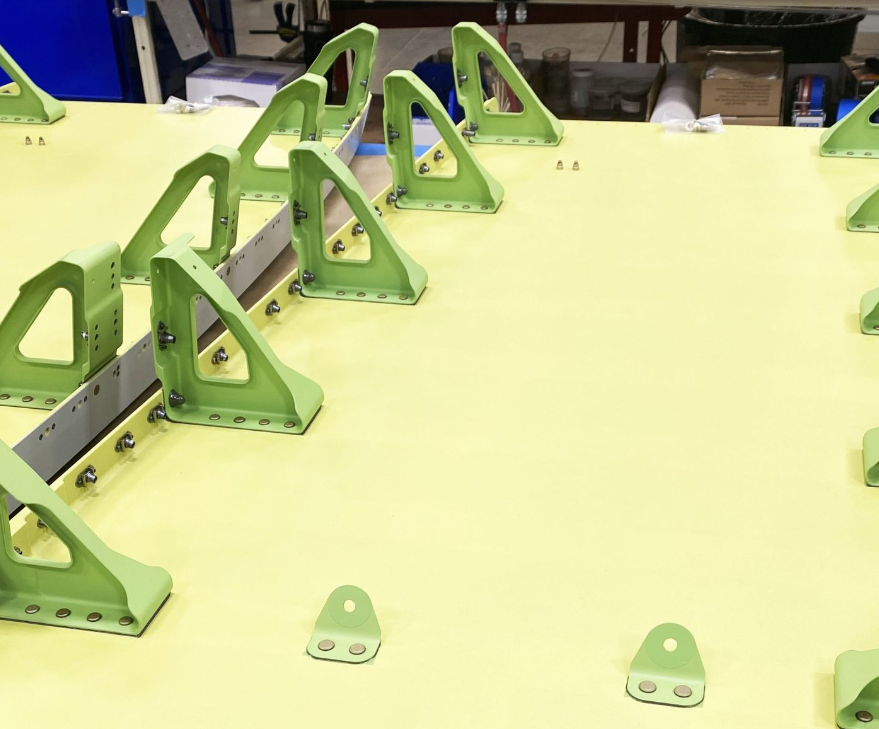
Transforming a block of high-strength alloy into a delicate, weight-saving aircraft structure is a complex dance of force, heat and control. For airframe components made from aluminum alloys, the primary hurdle is not cutting the metal but managing it. The goal is to remove vast amounts of material quickly to form thin walls, lattice structures and complex curves, all while preventing the part from vibrating, flexing or warping.
Techniques like the “Christmas tree” or waterline method are used. Staggered cuts are made to maintain a stable wall. This carefully manages the stresses within the material to preserve geometric integrity. And for the elaborate, aerodynamic contours common in modern designs, 5-axis machining becomes necessary. This allows for simultaneous movement along multiple axes, enabling the creation of smooth, complex 3D shapes from a single setup, which is vital for holding tight profiles.
When the material shifts to titanium – often used for engine mounts and other components facing extreme heat and stress – the game changes. Titanium is notoriously tough on cutting tools. Strategies must shift to manage heat, control vibration in deep pockets and protect tool life. This often involves using specialized tool holders to dampen vibration and employing machining paths like continuous ramping, which keeps the cutting load steady and predictable.
The A&G Difference
Holding the Line on Tolerances
What separates a good component from a great one is often measured in thousandths of an inch. Achieving ultra-tight tolerances on these advanced materials is the cornerstone of our work at A&G Machine. It’s a full-system effort that extends far beyond the cutting tool.
- Foundation in Technology: Our capacity begins with our equipment. We operate a fleet of 31 five-axis CNC machines, including high-speed machining centers specifically set up for large aluminum aerospace parts. This multi-axis capability is key, as it allows us to machine intricate features from multiple angles without re-fixturing the part, eliminating cumulative error.
- Rigorous Process Control: We build quality into every step. From initial programming using industry-standard software like CATIA and Vericut for simulation, to in-process checks and final inspection, our workflow is designed to catch and correct deviations early. We employ coordinate measuring machines (CMMs) and model-based definition to verify that every dimension, hole pattern and surface contour matches the digital design exactly.
- A Culture of Verification: Our certifications, including AS9100 Rev D for aerospace, are not just plaques on the wall. They represent a lived commitment to documented, repeatable processes. This systematic approach is what allows us to deliver consistently for programs like the F-35, F-22 and C-130, where there is no room for error.
The result of this meticulous focus is tangible. Lighter components directly translate to reduced fuel burn and increased range or payload. More precisely made parts fit together perfectly, reducing assembly time and improving the overall structural integrity and aerodynamic efficiency of the aircraft.
Partnering for the Future of Flight
The journey of a modern aircraft, from concept to flight, is built on collaboration. At A&G Machine, we see ourselves as an extension of our clients’ engineering teams. With over 125,000 square feet of manufacturing space and more than 40 years of history, we bring both the scale for production runs and the agility for prototyping new ideas.
Our experience spans the full spectrum. From the raw challenge of a new material like 2050-T84 to the exacting demands of producing large-scale wing spars, bulkheads and fuselage frames that can stretch over 322 inches in length. We understand that in aerospace, a machined part is never just a piece of metal. It’s an integral piece of a larger system where performance, safety and efficiency converge.
If you are designing the future of aerospace and need a partner who can navigate the complexities of lightweight alloys and transform them into reality, let’s talk. We can build what’s next. Together.